A sociological perspective on fans' behaviour
- Francesca Zanardi
- Jul 21, 2021
- 5 min read
Updated: Jul 22, 2021

The 11th of July, Italy won the Eurovision against England. I'm Italian, yet I'm not a big football fan. I'm one of those people who think soccer is just a game where 22 people get paid lots of money to chase a ball around. But that night, I was so excited. I was anxious after the first goal by the UK, and when the Italian goalkeeper, Donnarumma, parried that goal and led us to victory, I jumped off the sofa thrilled. So, after all the excitement, I started to question myself. Why did it matter so much to me? Why does football cause such a reaction in people? Reactions ranging from excitement to hatred. Why do we have this sense of belonging to our national football team? And since these reactions are intense and uncontrollable. Would a fan aided someone in need on the street that night if he/she had noticed the opposing team's shirt?
So, if you're interested in answering those questions, Continue reading...
Marx would describe sports consumption as a contributor to societal stability, firstly by distracting people from the exploitation of everyday life. And secondly, by reinforcing class division through the fans' subdivision in the stadium. But, "Fandom has come to form one of the principal media of collective identification in modern society and one of the principal sources of meaning in life for many people" (Dunning et al., 1986: 222). But why is that?
What differs from a spectator to a fan is whereas the first one watches directly or indirectly via the media. Fans are part of group membership, constituted by emotional significance and identity affiliation (Kremer, Moran, Walker, 2011). Many individuals are brought together by the shared emotional experience of singing, applauding, and cheering in unison. Fans openly express their affection for their team and their hatred for their opponents. Due to rising individualization and social differentiation, Durkheim said, that our society transitioned from mechanical to organic solidarity, losing collective effervescence, thus, the sense of community. What is more, the community gives individuals the capacity for empowerment through collaboration and support. Previously, community connectivity was felt internally through profound religious affiliation or societal union ship. Nowadays, however, this social relationship is expressed through exterior objects such as sports. In other words, we try to regain that sense of community lost (Cleland et. al, 2018).

Individuals, when in the presence of others act almost not like themselves. A process identified by Reicher (1984) where our self identity shifts to a social identity, therefore crowd members follow the typical and representative in-group behaviour. Another explanation is the process of Deindividuation, where we perceive a loss of self-awareness. Deindividuation combined with disinhibition generates a sense of anonymity, making people feel less responsible for their acts as individuals and hastening the likelihood of aggressive behaviour (Wolfgang & Hewstone, 2020).
Something that is strictly related to Sports fans is that they tend to say “we” won, not meaning themselves, personally, but as a process of identification or BIRG, “Bask In Reflected Glory”. In contrast, while Italy was not playing very well I always refer to "the team" or CORF-ing” means that you “Cut Off Reflected Failure.” In other words, after a loss, some fans distance themselves from the loss as much as possible. It’s not “we,” who lost, it’s “them!”.
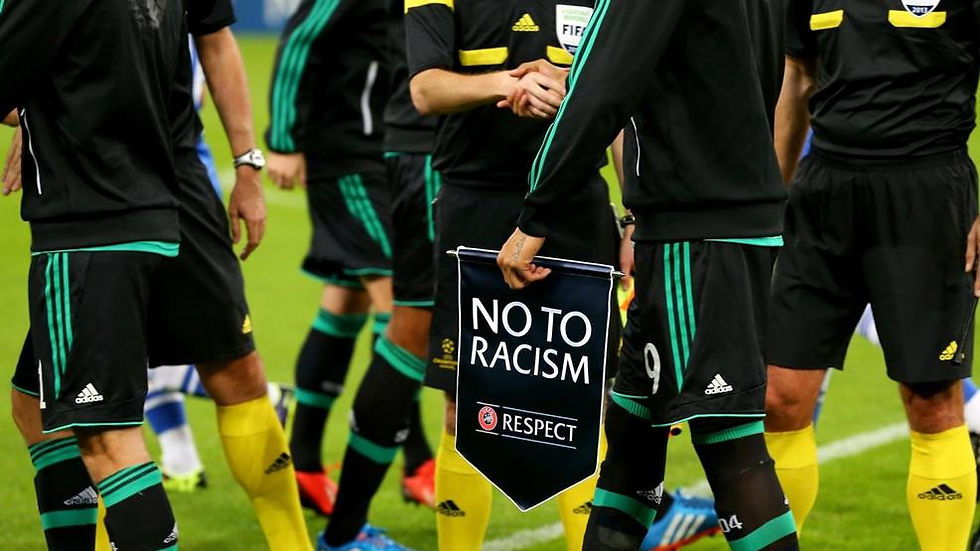
We also observed a case of racism against English players Marcus Rashford, Bukayo Saka, and Jadon Sancho, who were harassed on social media following the penalties. Racism, like football, is ingrained in most culture. However, this is at the foundation of not only the societal issue of racism, but also the phenomenon of violence aimed at an "out-group," or what we perceive to be one. What is more, in combination with deindividuation, the anonymity we experience in social networks, and the CORF-ing process, it is possible to identify this scenario of racism not only as an inherent societal problem (which occurs!) but also as a product of environmental and situational factors.
But if crowd behaviour in sports' environments can increase aggressive behaviour, can also be the cause of anti-social behaviour within competitive players fans?
Levine et al. (2005) asked: Does it matter who needs help?
In his study, he investigated the influence of bystanders relationship in helping behaviour. A group of participants, all Manchester's supporters wrote about being a Manchester United fan. Then, they were told to move to another building, and on the way there, an actor pretended to be injured. He wore a Manchester shirt, a Liverpool shirt or an unbranded shirt. Results showed that more people helped the jogger when he was a fellow compared to a Liverpool fan or regular jogger.
However, to ensure that the influence was due to ingroup membership, Levine et al, (2005) ran a second trial in which individuals wrote just about being a football fan and then went to the opposite building and found the injured jogger wearing one of the shirts described above. Surprisingly, in this scenario, the data showed that when the jogger was a football fan, more individuals aided than when the jogger was an ordinary jogger. These two studies demonstrate that when people regard the person in need as a fellow in-group member, they are more likely to help since they share a common group identity.
Sports, not just football, are a great opportunity for people to create a community and a sense of belonging that help to step away from everyday alienation. But as we have seen, crowd behaviour can influence our self-awareness and make us react to situations quite differently from what we would normally do. Even tough it is difficult to prevent our behaviour in these circumstances, try to dissociate yourselves from the crowd, and if you find yourself in a bad situation due to your group, alaways remind yourselves that you are an individual in a mass, you can act individually for the better outcome of your group.
Reference list:
Karen, D. & Robert, E. (2015). Sociological Perspectives on Sport: The Games Outside the Games. Washington: Taylor & Francis Group.
Fans and spectators. (2011). In J. M. Kremer, A. Moran & G. Walker, SAGE Key Concepts series: Key Concepts in Sport Psychology (1st ed). Sage UK.
Cleland, Jamie and Doidge, Mark and Millward, Peter and Widdop, Paul (2018) Collective Action and Football Fandom A Relational Sociological Approach. Palgrave Macmillan
Wolfgang, S. & Hewstone, M. (2020). An introduction to social psychology. John Wiley & Sons Ltd: Canada.
Levine, M., Prosser, A., Evans, D., Reicher, S. (2005) Identity and Emergency Intervention: How Social Group Membership and Inclusiveness of Group Boundaries Shape Helping Behavior In Personality and social Psychology Bulletin 31(4) 443-53. DOI:10.1177/0146167204271651


Comments